Astronomers Find Rare Supermassive Neutron Star
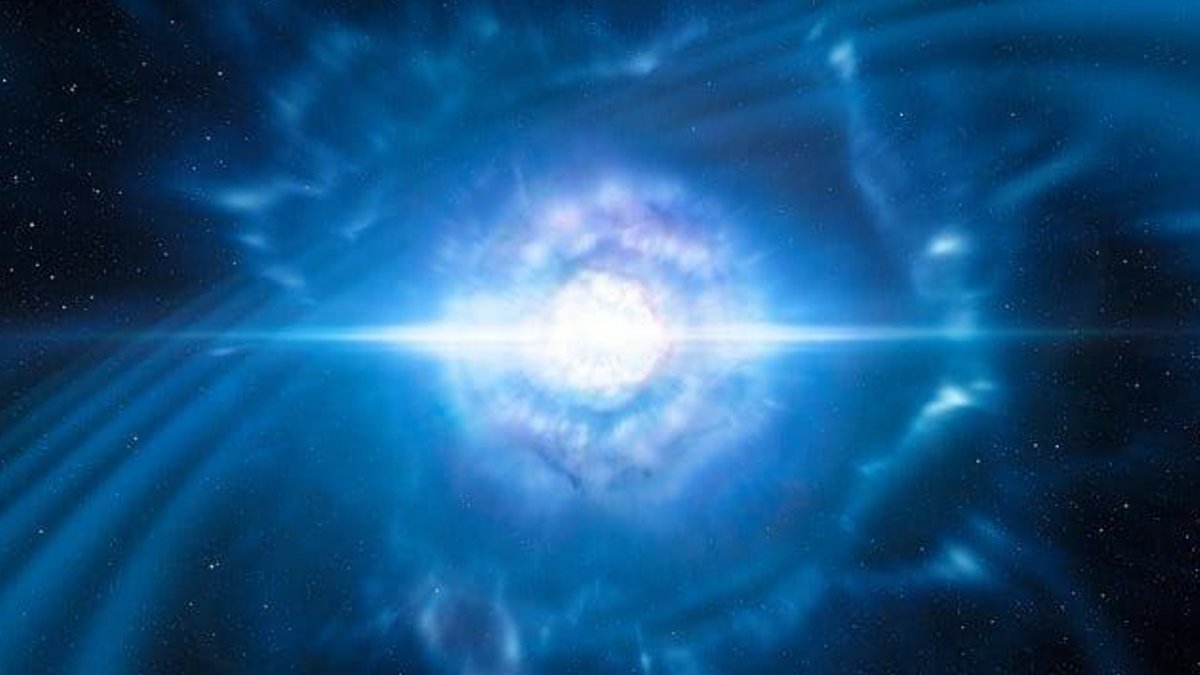
Astronomers have uncovered an enigmatic, unseen celestial body defying conventional theories about stellar death and formation. Positioned within the J0008+0128 system, this object appears to be an exceptionally rare supermassive neutron star—the dense remnant core of a star that exploded as a supernova. Its gravitational influence on an orbiting red giant star first revealed its presence.
The object’s unusual mass and orbital behavior have left researchers baffled, as extensive computer modeling failed to replicate its characteristics. The findings were published in a study appearing Wednesday in Science Advances.
Neutron Stars and the Mass Gap Mystery
When massive stars explode in supernovae, their cores typically collapse into either neutron stars or black holes—both classified as “stellar remnants.” However, scientists have long struggled to explain why few objects exist with masses between 2.5 and five times that of the Sun, a range known as the “mass gap.”
The newly identified object in J0008+0128 may weigh up to 2.8 solar masses, placing it squarely within this unexplored region, the study suggests. Such an extreme mass challenges existing models of stellar evolution.
Read Also: AI firms block reverse-engineering tools for users
Unlike white dwarfs, Earth-sized remnants of Sun-like stars, neutron stars are minuscule, measuring only a few miles across. Their interiors consist of crushed atomic particles, primarily neutrons, along with protons and electrons, packed under unimaginable pressure.
The Detection Process
Song Wang, an associate researcher at the National Astronomical Observatories of China’s Academy of Sciences and a co-author of the study, explained that his team locates compact objects, primarily neutron stars and black holes, through large-scale spectroscopic surveys. Among over a dozen neutron stars they’ve discovered, J0008+0128 stands out as the most massive.
Stars exceeding 25 solar masses typically form black holes upon collapse, while those between 10 and 25 solar masses become neutron stars. Smaller stars, similar in size to the Sun, end their lives as white dwarfs, objects far larger and less dense than neutron stars.
The system’s peculiarities extend beyond its mass. With an orbital period of 1,218 days, the neutron star’s wide separation from its red giant companion defies standard formation theories. “We have found more than 10 neutron stars, and J0008+0128 is the most massive one among them,” Wang reiterated.
Read Also: Father leaves 6-year-old alone in Pokémon card line
Broader Scientific Implications
The discovery offers a rare opportunity to probe the “equation of state”, the relationship between pressure and density, inside neutron stars. Wang noted that this fundamental question in astrophysics remains unresolved, and precise mass measurements of neutron stars could provide critical clues.
Yet the system’s strangeness doesn’t end with the neutron star’s mass. Despite running thousands of simulations, none successfully replicated J0008+0128’s observed properties, the study reports. This suggests alternative formation pathways may be at play.
Wang and his team propose several explanations for the system’s anomalies. One possibility is that supernovae occasionally produce neutron stars within the mass gap. Another scenario involves a past triple-star configuration, where two objects merged to create the observed supermassive neutron star.
Upcoming Gaia data releases, expected next month, may further constrain the unseen object’s mass. Together with recent discoveries like Gaia BH2 and G3425, the findings show ongoing gaps in our understanding of binary star systems and supernova mechanics.


