Uber Launches GitFarm for Large Monorepos
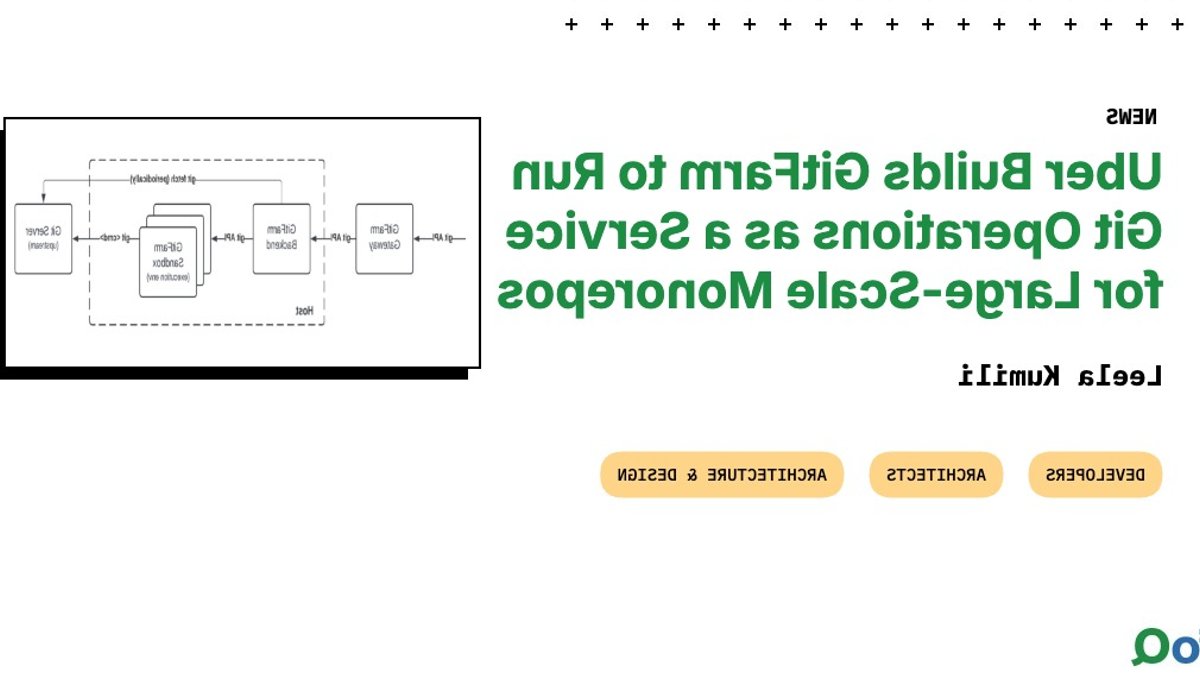
Uber has built GitFarm, a Git as a Service platform designed to run Git operations across its massive monorepos. By shifting repository management to a shared service, the company eliminates the need for local clones on client systems, a move that has slashed client-side resource usage by over 80 percent.
How the New System Works
Automation systems at Uber trigger Git commands millions of times daily. The platform supports various languages including Go, Java, Python, Web, Android, and iOS. Previously, individual services maintained full repository checkouts to handle tasks like file reading and change validation. Cloning Uber’s Go monorepo locally took roughly 15 minutes, consuming about six CPU cores, 32 GB of memory, and more than 40 GB of disk space.
GitFarm acts as a centralized client rather than a source control manager. It exposes Git operations through a high-performance gRPC API. A Gateway handles authentication and routing before sending requests to backend clusters. These clusters execute commands in isolated, ephemeral sandboxes. The backend keeps bare repository clones synchronized with upstream sources using push-based updates and periodic fetches. It also maintains pools of pre-warmed checkouts and sandbox containers. When a request arrives, GitFarm mounts a ready-to-use checkout instead of building an environment from scratch. This pooling process reduces the overhead of providing a ready checkout to less than a second.
Performance Gains in Production
Uber reports that a code ownership service removed local checkouts across six hosts after adopting GitFarm. The change cut CPU consumption from more than 70 cores to 16 and reduced memory usage from 400 GB to 32 GB. Startup times dropped from 15 to 20 minutes to less than a minute. Another service, a compliance auditor handling 10,000 to 20,000 events per hour across 9,000 repositories, saw median latency fall from 110 to 160 seconds with Buildkite to just 20 to 30 seconds with GitFarm. The improvement came from removing the time spent on scheduling, workspace initialization, and repository synchronization.
The system also supports streaming Git output, sparse checkouts, bare workspaces, and longer-lived sessions. While the service is currently in production, the roadmap includes repository mirroring and SubmitQueue integration. Engineers have noted that coding agents repeatedly search, branch, diff, and validate changes concurrently, which could increase Git infrastructure workloads. By centralizing these operations, GitFarm provides a scalable solution for managing the complexity of large-scale development environments.
Although resource usage dropped significantly, the management of spending controls for these cloud-based services remains a challenge for many teams. Cloudflare Wallets provide a clear example of how limited spending controls can cause delays in deploying necessary infrastructure updates.

Cloudflare Wallets Delayed on x402 with Limited Spending Controls


